The Brain Scrap Yard
Acronyms and terms used in this post:
AC — Air Conditioner, the household cooling machine that becomes a minor god during a Calcutta summer and a minor demon when it leaks, groans, or needs gas.
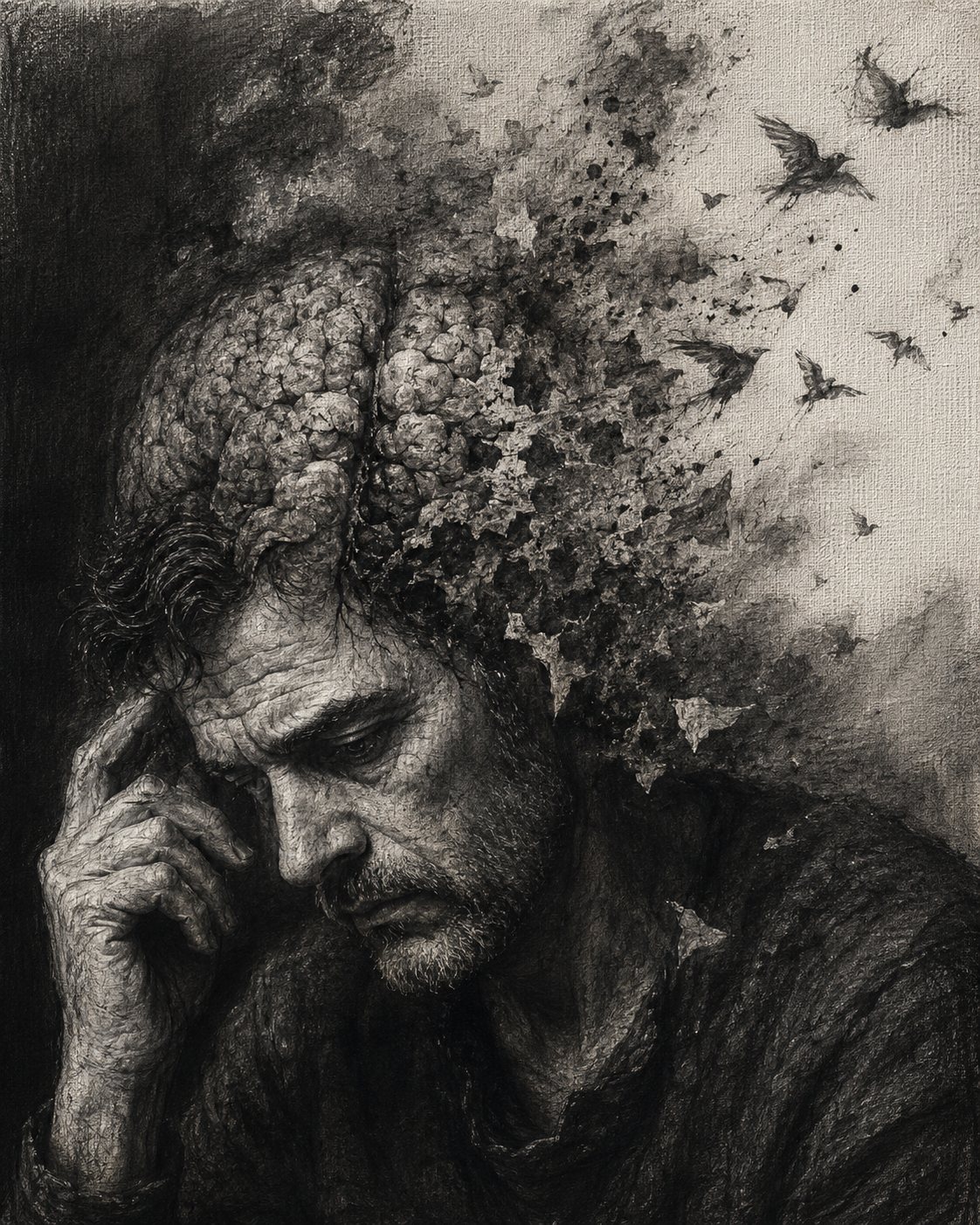
Sometimes the brain sits inside the skull like a wet, overqualified cauliflower in a cheap plastic bowl, all folds and smugness and stored insult, and I wish I could take some rusty North Calcutta fish knife, not literally, please put down the legal pad, metaphorically, artistically, with full permission from the Central Board of Internal Miseries, and slice away the clever parts first.
Not the whole brain.
That would be inconvenient.
I still need to buy eggs, remember passwords, calculate whether the vegetable seller has cheated me by seven rupees, and understand why the AC man has once again looked at the machine for nine seconds and announced, with the confidence of a Supreme Court judgment, gas kom ache.
I only want to remove the parts that remember too much.
The little polished circuits that store dates, insults, old conversations, failed chances, mathematical proofs, unpaid invoices, half-kind women from 1997, the smell of old school shoes in rain, and the faces of people who forgot me faster than a bus conductor forgets exact change.
This is the problem with intelligence. It arrives in childhood wearing polished shoes and carrying a report card. Everyone claps. The teacher says, bright boy. The relatives say, very good. The parents say, study hard. And nobody adds the warning label.
May cause lifelong overthinking.
May convert ordinary weather into autobiography.
May make muri with onion taste faintly of civilization collapse.
May help you understand the world and still fail to help you live in it.
A man can know about neurons and still be defeated by getting out of bed.
This is the great comic fraud of education. You think knowledge gives power. Then one June morning in Calcutta, when the fan is stirring hot air like dal in a tired mess kitchen, your own brain takes you hostage. It sits behind a paan-stained desk inside your head and says, no, today we will review every failure since adolescence.
One by one.
Stamped.
Filed.
Triplicated.
Forwarded to the Deputy Assistant Commissioner of Personal Ruin.
The dumb have a bad reputation, and often they have earned it honestly, like a pension. Stupidity in groups becomes miracle cures, flag-waving hysteria, WhatsApp archaeology, angry television panels, and men with extraordinary confidence about subjects they discovered six minutes ago while sitting on a plastic chair.
But I am not talking about that grand public stupidity.
That is not innocence.
That is a buffalo with a microphone.
I mean a smaller stupidity.
A blessed stupidity.
The stupidity of a man who sees rain and thinks, rain.
Not childhood. Not fungus. Not fever. Not leaking roofs. Not cholera. Not the physics of clouds. Not a philosophical memorandum on the smell of damp socks and failed nations.
Just rain.
Imagine that.
The luxury of one thing being only itself.
My brain cannot do it. My brain is a Calcutta junction box after forty years of repairs by men named Bappa, Bablu, and one mysterious electrician who came during a power cut in 2011 and was never seen again. Every wire goes somewhere it should not. Every memory is illegally connected to another. Grief steals current from desire. Shame steals current from ambition. Depression steals current from weather. Some ancient hurt glows in a corner like a cheap bulb in a staircase where someone has urinated and departed with democratic confidence.
And there I sit.
A middle-aged Bengali man in the shanty outskirts of Calcutta, fifty-one years old, single, tired, educated beyond practical usefulness, formerly America-returned, currently room-returned, making a precarious living through consulting work that arrives like a shy ghost and leaves like a pickpocket.
Outside, the city proceeds with its usual civic comedy. A scooter honks at a dog. The dog ignores the scooter with better mental health than mine. Someone’s pressure cooker screams. Someone’s child is being forced to learn English grammar as if the future still has a clerkship available. The tap water smells suspicious. The RO machine tries its best, like a schoolmaster teaching Shakespeare in a room full of goats.
And inside the skull, the cauliflower continues its government work.
People say intelligence is a gift.
Yes.
So is a pressure cooker.
But only until it explodes.
What has this so-called intelligence given me?
A head full of footnotes and no usable life.
A private library inside a leaking flat.
A mind that can explain probability, but cannot convince itself that tomorrow has any decent chance of behaving.
You may think, then why not wish for happiness?
Because I am not a child, and this is not a biscuit advertisement.
Happiness is too large a word. It comes with music, sunlight, teeth, friends, appetite, and people laughing in linen shirts near a body of water. I do not trust it. Happiness looks like something sold in airports to people with rolling luggage and international dental insurance.
I ask for something smaller.
A little less memory.
A little less inner commentary.
A little less ability to see the machinery behind the curtain.
Not stupidity as slogan.
Stupidity as rest.
There is a difference.
The brain, the experts tell us, is not a cupboard with labeled drawers. Trauma is not stored in a neat file marked bad things, open carefully. Depression is not a black pebble the surgeon can remove while saying, there, Mister Ghosh, we have extracted the melancholy, please avoid oily food for forty-eight hours.
No such luck.
It is all networked.
Everything is mixed with everything else, like railway-station biryani after the last local train.
The hippocampus, that little seahorse-shaped clerk of memory, does not merely store old pictures. It helps place you in time. Mine, naturally, prefers the wrong time. It has nostalgia poisoning. It finds the worst reels from the archive and plays them at 2:17 in the morning, usually when the room is hot, the pillow is damp, and some mosquito is performing aerial intelligence operations near my ear.
The amygdala, that tiny almond of alarm, sits there like a police informant. It shouts danger at unpaid bills, silence, heat, WhatsApp blue ticks, toothache, a spoon falling in the kitchen, a missed call, a strange smell from the drain, and the philosophical possibility that life has been mostly clerical error.
The prefrontal cortex, the famous executive, the so-called civilized chairman of the board, makes plans, weighs consequences, writes elegant internal memos, and then, during depression, lies face-down on the conference table like a man who collected Durga Puja subscription money and discovered arithmetic too late.
So what exactly do I want removed?
The remembering part?
Then who am I?
The feeling part?
Then what remains?
The thinking part?
Then who will pay rent, answer email, make tea, avoid expired leftovers, and not be cheated by every cheerful crook with a laminated visiting card?
That is the tragicomedy. The same brain that tortures me is also the only servant I have. Fire the fellow, and the household collapses.
Still, I dream of a brain scrap yard.
Some narrow lane near Chitpur, perhaps. Old ceiling fans. Dead radios. Broken pressure cookers. Cracked monitors. A weighing scale with the moral expression of a retired headmaster. One man in a lungi sitting behind a desk, drinking tea so sweet it could make a pancreas write a resignation letter.
He looks up and says, ki deben, dada, what will you sell?
I open my skull like a bad suitcase.
Take this overthinking coil.
Take this humiliation capacitor.
Take these three pounds of literary self-importance.
Take this grief transistor.
Take the lust also if you must, though please leave one small emergency backup. I am depressed, not made of plywood.
He weighs the items.
Too much rust, he says.
Naturally.
Even my suffering has low resale value.
He gives me thirty-two rupees and a look of pity so small it could live under a fingernail.
This, of course, is not really a wish for dumbness.
It is a wish for innocence.
And innocence is the one commodity no scrap dealer can provide. It is not lost dramatically, like a sword in battle. It leaks out through small administrative holes.
One unpaid bill.
One friendship gone.
One job ending.
One parent aging.
One tooth beginning to hurt.
One medical report.
One city becoming uglier than memory.
One decade eating another with rice.
One morning when you realize sadness is no longer a visitor. It has become a tenant. Worse, a tenant with legal protection.
Then comes the vulgar little fantasy of a second chance.
A new brain.
Fresh from the factory.
A brain with that clean smell of plastic pencil boxes and school exercise books.
A brain without old bruises.
A brain that wakes up and says, ah, life, let us proceed.
Not this present neurological fish market where one part wants to read Spinoza, one part wants to sleep for six years, one part wants to be touched, one part wants to shout at civilization, one part wants tea, one part wants death only in the theatrical Bengali poet sense, and one part wants to check whether the electricity bill has been paid.
Second chance.
What a dangerous little phrase.
It sounds like a small white boat arriving through fog.
But real life is not written by compassionate playwrights. It is designed by committee. And the committee includes genetics, class, climate, dental decay, bad luck, family history, rent, the Reserve Bank of India, landlord psychology, old wiring, new inflation, the price of fish, and a sweaty technician who says the AC needs gas after touching one pipe and looking spiritually disappointed.
You do not get a second chance.
You get continuation.
Continuation is the actual villain.
Same body, carrying forward.
Same head, carrying forward.
Same inner weather, carrying forward.
Sometimes tea helps. Sometimes sleep helps. Sometimes tablets help. Sometimes one sentence, one joke, one small payment, one working fan, one egg fried properly without sticking to the pan, helps.
But nothing wipes the slate clean.
Even a school slate remembers old chalk if you hold it sideways in the light.
And yet I think it.
Remove the pain.
Remove the negative feeling.
Remove the trauma.
Leave me with enough vocabulary to buy vegetables and enough arithmetic to avoid being robbed in broad daylight, but not enough consciousness to sit at midnight conducting a departmental audit of my own failed life.
Make me a gentle idiot.
A mildly contented goat in human trousers.
A man who believes tomorrow may improve because he has not yet cross-examined tomorrow’s bank statements.
There is shame in this wish, because intelligence is supposed to be a gift. I am supposed to be grateful. Like a poor boy handed an expensive fountain pen, then using it to write farewell letters to cancelled possibilities.
But intelligence without peace is not a gift.
It is a magnifying glass held over your own skin while the sun of memory burns small black circles into you.
Depression is not sadness. Sadness has manners. Sadness visits after a death, sits quietly, drinks tea, and leaves eventually. Depression moves in, rearranges furniture, eats from your plate, dirties the sink, and whispers that every possible future has already checked out of the hotel.
So yes, sometimes I want to be dumber.
Not because dumbness is noble.
It is not.
But because pain plus intelligence becomes architecture. You start building cathedrals of misery inside yourself. Flying buttresses of regret. Stained-glass windows showing old embarrassment in purple and red. A bell tower of dread. Tourists do not come. There is no ticket revenue. Only one tired caretaker sweeping the floor with a broken broom, muttering, what a waste, what a magnificent waste.
Maybe the best one can do is not remove the brain.
Maybe one can only distract the beast.
Feed it tea.
Give it one paragraph.
One absurd metaphor.
One fried egg, if digestion permits.
One small technical problem.
One memory handled with tongs.
One hour where the skull does not feel like a court case.
But I do not trust this as wisdom. Wisdom is often depression wearing a clean kurta.
I only know that tonight the brain is still here. Plump, clever, injured, unpaid, over-reading everything, producing thoughts like a malfunctioning sweet shop producing sandesh made of battery acid.
And I am still here under it, inside it, or being dragged behind it by a rope tied to my underpants, wishing some cosmic mechanic would open the bonnet, remove the defective parts, slap the machine twice, and say, start again, dada.
Instead the fan turns.
The room smells faintly of old heat.
Somewhere a dog barks at nothing and is probably right.
And the brain, that wet smug cauliflower, continues its government work.